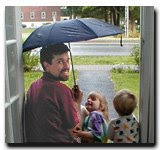
Here at our store, F.W. Horch Sustainable Goods and Supplies, 56 Maine Street, Brunswick, we will host a showing of "Gardeners of the Spirit," followed by a discussion led by Brunswick filmmaker Eric Herter on Thursday, April 9, at 7:00 pm. The event is free and open to the public.
"An Arizona-based group working to install school and community gardens asked us to talk with them about a documentary on their projects," said Herter. "Out of these talks came the idea that the film should cover the works of 'gardeners of the spirit' across the US, as they build community through the collaborative creation of peaceful, beautiful green sanctuaries in cities, schools, hospitals and prisons."
Starting in Maine, Boston, the Bronx and North Philadelphia, Brunswick residents Eric and Hoa Herter began shooting "Gardeners of the Spirit." They then moved by rent-a-car (daughter and all) from Minneapolis to Des Moines, St. Louis, Fort Worth, Phoenix, LA and the Bay Area, seeing vibrant gardens in ruined city-scapes, and recording meetings with remarkable people. "Gardeners of the Spirit" attempts to convey some of the spirit of the gardens and their creators.
Eric will be on hand to discuss his experiences making the film and share information about the proposed Brunswick Park and Gardens. He worked for years as a magazine writer/ photographer/ editor before starting to produce independent TV films for film festivals and local PBS affiliates. In the mid-'90s he became the producer for Associated Press Television in Hanoi, Vietnam, making videos for worldwide broadcast on Vietnamese human-interest and environmental topics. While with AP, he met and married Tran Thi Hoa, a photographer doing photo assignments for non-governmental organizations (NGOs). After their daughter was born in the late '90s, Hoa and Eric teamed up to produce video documentaries for the UN, international broadcast networks, and NGOs doing development and environmental work in Vietnam . Several of their environmental films are re-broadcast regularly in Vietnam.
Space is limited, so those interested in attending are encouraged to call the store at 729-4050 to reserve a seat.
This event is part of the F.W. Horch series on sustainable living. Each monthly event is held at the F.W. Horch Sustainable Goods & Supplies store, 56 Maine Street, Brunswick on the second Thursday of the month.
For more information, please call 729-4050 or visit www.FWHorch.com.
Thursday, April 02, 2009
Gardeners of the Spirit


Wednesday, March 04, 2009
Compost and Castings
When starting seeds, use 1 part finished compost or worm castings to 3 parts potting mix to give your little plants a healthy head start without synthetic fertilizers.
- It's easy to make your own compost or worm castings from kitchen scraps.
- When micro-organisms decompose organic matter, the result is called "compost". Finished compost is dark brown or black, crumbly, and has a mild organic aroma like mushrooms.
- When worms process organic matter, the result is called "castings". Castings look like wet coffee grounds and smell like healthy soil.
- Both compost and castings provide essential nutrients for growing plants.
- Most families can produce enough compost or castings to provide a rich mix for starting their seeds.
- You'll need to add some dry materials like shredded paper, leaves, or clean sawdust to your kitchen scraps. Adding these materials helps the decomposing process go faster without nasty odors.
- A plug-in kitchen composter like the NatureMill reliably produces compost in two weeks by maintaining the perfect conditions for hot composting by microbial cultures. The compost it produces is ready to use right away, or can be stored for later use.
- Worm bins generally take a little longer to produce results--about six weeks start to finish--depending on temperature, the type of food scraps, and the appetite of your worms. Worm castings can be used as is, but if you plan to store them for later use, you'll probably want to dry them first.
- Worms like the same temperatures as we do, but will tolerate cool temperatures down to the mid-50s and high temperatures into the mid-80s. They work best in the low-70s.
- If you put a worm bin in your basement, use a portable thermometer to determine the temperature range. Near the boiler is often a convenient and relatively warm location.
- Keeping your kitchen scraps out of your garbage benefits you and your community; neither landfills nor incinerators need wet organic waste.
- Whether you make compost or castings, most of your kitchen waste will literally vanish into thin air as the process creates water vapor and carbon dioxide.
- Compost and castings improve the texture and health of soil, helping it retain moisture while allowing roots to penetrate.
- Recycling organic nutrients back into the soil completes the cycle of life and allows new plant growth to occur without requiring exogenous synthetic chemical inputs.
- Building healthy soil with compost and castings is an essential part of successful organic gardening.
- Besides mixing compost or castings in your seed-starting medium, you can also use them as a top dressing periodically in your garden, around trees, or on your lawn.
- A kitchen compost pail makes it easy to collect scraps. A tight-fitting lid with a charcoal filter controls odors and keeps everything contained until you're ready to add it to your composter or worm bin.
- It's fine to toss your kitchen scraps in an outdoor compost pile all winter. They won't start composting outdoors until warmer temperature arrives, but there's no harm in letting your food waste freeze and thaw before it turns into compost.
- Some people even store their kitchen waste in their freezer until spring. This isn't as crazy as it sounds. It actually helps your freezer's efficiency to be full rather than empty, and if you ever lose power, hunks of frozen garbage can keep your food cool. Just make sure you label everything carefully!
- Composting equipment, information and supplies, including worms and worm bins, are available year round at F.W. Horch in Brunswick and online at www.FWHorch.com.
Featured Products for March 2009
Ordering on your own from Fedco? Put your order in with ours and save on shipping and handling. We'll be placing our next order TOMORROW (Thursday, March 5) to beat their March 6 backorder deadline. After March 6, Fedco seed orders are filled from stock on hand.
NOTE: Available for pick up in store only.
Environmental Happenings
What's Happening in the Local Environmental Scene and Beyond
Events in Maine
Saturday, March 7 - Hands On Fermentation Workshop, 1:00-3:00 pm, Freeport Community Library, Freeport. Local organic farmers Chris Colson and JoD Saffeir will share their experiences while working at Tenuta di Spannocchia in Sienna, Italy. Hands-on sauerkraut making / lactofermentation workshop to follow. For more information, visit www.FreeportLibrary.com.
Tuesday, March 10 - Cooking with Locally Grown Food, Noon-1:30 pm, Curtis Memorial Library, Brunswick. Ken Cardone of Bowdoin College Kitchens, Kris Lindsey of Hannaford Bros. Market, Aaron Park of Henry & Marty's Restaurant, and Amy Winston of Focus on Agriculture in Rural Maine Schools discuss the benefits and challenges of cooking with locally produced food. Moderated by Tyson Weems of The Health League, Inc.
Wednesday, March 11 - Book Discussion: Animal, Vegetable, Miracle, 6:30-8:00 pm, Curtis Memorial Library, Brunswick. Facilitated by Gary Lawless of Gulf of Maine Books and Eloise Humphrey of El Camino Restaurant.
Thursday, March 12 - Starting an Organic Vegetable Garden, 7 pm, F.W. Horch Sustainable Goods & Supplies, Brunswick. Master gardener volunteer Brett Thompson explains how to start your own organic vegetable garden. Are raised beds a good idea? Will mulch save you time on weeding and watering? How can you improve your soil? Join us to find out. Seating is limited, so please reserve a space by calling us at 729-4050.
Sunday, March 15 - Caring for Rhododendrons and Azaleas, 1:00 pm, Curtis Memorial Library, Brunswick. Brunswick Park and Gardens is hosting a garden talk by Tom York of York's Rhododendrons to discuss the proper care, feeding and pruning of rhododendrons and azaleas. For more information, call 833-5125.
Monday, March 23 - Off the Grid: Tours of a Working Farm, 10 am-Noon, Milkweed Farm on Gott Lane, Brunswick. Owners Lucretia and Michael Woodruff, with Eloise Humphrey of El Camino Restaurant, will show visitors how a small family farm works. The family raises their own vegetables, turkeys, pigs, chickens, eggs and dairy products.
Tuesday, March 31 - The World According to Monsanto, 6:00 - 8:30 pm, Curtis Memorial Library, Brunswick. "The World According to Monsanto" is a provocative documentary by French filmmaker Marie-Monique Robin that unveils the motives and work of the Missouri-based biotechnology giant Monsanto. The film leads the viewer to explore the history of food and the seed upon which we rely for sustenance. Questions and Answers to follow the film.
MIT's Joint Program on the Science and Policy of Global Change finds that it is more likely that global warming by the end of the century will be greater than previous studies have projected. The MIT researchers used an in-house computer model known as the MIT Integrated Global System Model that incorporates new insight into how the climate system functions. MIT's "Greenhouse Gamble" conveys the "range of probability of potential global warming" via roulette wheel graphics. The output unveiled in February 2009 shows that the odds have shifted in favor of larger temperature increases. "The take home message from the new greenhouse gamble wheels is that [...] the dangers are much greater than we thought three or four years ago," said Ronald G. Prinn, professor of atmospheric chemistry at MIT.
Tainted peanut products in North America have made 604 people sick, sent 187 to the hospital and killed eight so far in 2009. The salmonella outbreak in processed peanuts also has led to more than 2,000 product recalls in the U.S., more than any other food epidemic, according to Dr. Sylvain Charlebois, a food distribution and safety specialist and associate dean at the Levene Graduate School of Business, Faculty of Business Administration, University of Regina. "Globalization has had a significant impact on how we eat and has kept food prices at reasonable levels. But an unfortunate side affect is that our capacity to manage risks has been severely compromised," writes Dr. Charlebois. "The 'cheap calorie' factor is also putting a lot of pressure on food industry stakeholders. [...] Today, Canadian and American consumers spend only about 10-12% of their disposable income on food purchased from a store. That number was at around 25% less than a generation ago."
Clearance Corner
We've got some great deals for you in our "Buy One, Get One Free" Clearance Corner. Need to prime or paint a room? Get two gallons of Safecoat wallboard primer for just $31.90! Stop by or give a call to see what we've got in stock. At the moment, we're still clearing out American Pride and Safecoat paint, Durostain wood stain, and a variety of AFM sealers. Let us help you save your lungs and your money!
Tuesday, March 03, 2009
Organic Gardening Workshop
On Thursday, March 12, from 7:00 pm to 8:30 pm, our store will host a gardening workshop, "Starting an Organic Vegetable Garden," by Master Gardener Volunteer Brett Thompson. The workshop is free and open to the public.
"We'll help you get started growing your own organic vegetables," says Brett Thompson, a Master Gardener Volunteer and F.W. Horch manager. "Our workshop will emphasize organic and sustainable methods of gardening because that's just the way we are."
Topics will include the pros and cons of raised beds, how to reduce weeding and watering by using mulches, and methods of improving your soil. No prior gardening knowledge is assumed or required. Time will be provided for questions and answers.
Space for the workshop is limited, so those interested in attending are encouraged to call the store at 729-4050 to reserve a seat.
This workshop is part of the F.W. Horch series on sustainable living. Each monthly talk is held at the F.W. Horch Sustainable Goods & Supplies store, 56 Maine Street, Brunswick on the second Thursday of the month.
Wednesday, February 04, 2009
Solar Spaceheating: February's Sustainable Living Tip
Using solar energy for space heating is five times more affordable and four times more efficient than using solar energy to generate electricity.
More Facts About Solar Space Heating
- Solar space heaters (solar air thermal systems) collect heat from the sun and pump it inside on sunny days, while preventing heat from escaping at night or during cloudy days.
- Because they consume no fossil fuel during use and rely on solar energy that shines directly on the building where they are installed, solar space heaters have the lowest total environmental impact of any heating system available today.
- Solar space heaters have been successfully used in Maine since the 1970s. During that decade's energy crisis, several magazines published “do-it-yourself” plans for building solar space heaters from spare lumber and plate glass.
- Unlike the “do-it-yourself” wooden boxes from the '70s, modern solar space heaters feature aluminum frames, optimized glazing and absorber plates, back-draft dampers, and thermostat controls. Their expected useful lifetimes is 30 years.
- At Maine's latitude, solar space heaters are typically installed vertically on southern-facing walls. This maximizes winter solar gain and eliminates snow accumulation concerns.
- Solar space heaters cost about $1,700 per installed kilowatt, compared to $9,000 per installed kilowatt for solar electric (photovoltaic) systems.
- Total installed cost for a 1.5 kW SolarSheat space heater from F.W. Horch is $2,500, or you can buy the unit for $1,979 and install it yourself.
- Solar space heaters require no electric or plumbing connections, so they can be easily installed by carpenters or homeowners. They work just as well on a house in the suburbs as on a remote camp in the wilderness.
- In new construction, solar space heaters can be built into southern-facing walls, taking the place of siding.
- On existing buildings, solar space heaters are mounted on top of the existing siding or on the roof.
- Solar space heaters can also be ground mounted with heating ducts installed underground.
- The SolarSheat space heater has an SRCC efficiency rating of 625 watts per square meter, more than four times higher than a typical solar PV (electric) panel, which has an efficiency of less than 150 watts per square meter. (Solar efficiency ratings are based on insolation of 1,000 watts per square meter.)
- The reason solar space heaters are able to achieve four times greater efficiency than PV panels is that solar space heaters absorb a wider spectrum of solar energy and transfer the sun's heat energy rather than convert it to an electric current.
- During summer months when no space heat is needed, a solar space heater can simply be covered to shade it from the sun, or it can be controlled by a thermostat to prevent it from transferring heat inside.
- Combination solar space heaters and solar water heaters are available. These units operate as space heaters during the heating season and as water heaters during the rest of the year.
- Maine's solar rebate program covered solar space heaters. It is unclear whether state funding for this program will continue, or whether federal funding will become available. According to Efficiency Maine, “Rebates for solar photovoltaic (PV) and solar thermal installations are no longer available, as of January 16, 2009. Due to high demand and resource limitations, all of the funds made available for these programs have been allocated for this year. Under current law, the programs are due to receive renewed funding in January of 2010.”
- Solar space heaters can be used to reduce the heat load of any building with a sunny wall or roof, but they are best used in combination with electric heat or with high efficiency direct-vent combustion heaters that allow for air-tight and super-insulated construction.
- Climate data and heat loss models show that super-insulated buildings with heat storage and heat recovery ventilation systems can be heated entirely by solar space heaters to maintain a comfortable 68 degree Fahrenheit temperate year round in Maine.
- While reducing heating bills by 100% is theoretically possible with solar space heaters, heat load reductions of 25% to 50% are more reasonable targets for existing homes that are well insulated and weatherized. The remaining 50% to 75% of the heat load could be met with a wood stove or electric space heaters.
Featured Products for February 2009
Large drying rack $75
42" for doors $19.95
Vornado Electric Space Heater
Environmental Happenings
Events in Maine
Clearance Corner
We've got some great deals for you in our "Buy One, Get One Free" Clearance Corner. Need to prime or paint a room? Get two gallons of Safecoat wallboard primer for just $31.90! Stop by or give a call to see what we've got in stock. At the moment, we're clearing out American Pride and Safecoat paint, Durostain wood stain, and a variety of AFM sealers. Let us help you save your lungs and your money!
Tuesday, February 03, 2009
Sustainable Coffee Talk
On Thursday, February 12, from 7:00 pm to 8:30 pm, our store will host "Sustainable Coffee: From Crop to Cup," a talk by Bob and Carmen Garver, owners of Wicked Joe Coffee . The talk is free and open to the public and will be held at our store, F.W. Horch Sustainable Goods and Supplies, 56 Maine St., Brunswick.
"Our mission at Wicked Joe Coffee is to roast epic coffee in a manner that is kind to the earth and to the farmers who painstakingly grow our tasty beans," says Carmen Garver, who recently returned from a sustainability trip to a number of Rainforest Alliance coffee farms in El Salvador, meeting the farmers and working alongside them.
According to some estimates, coffee is the second-largest commodity trade on the globe, employing 25 million people worldwide. All of the producing regions are in equitorial latitudes -- none in the continental United States -- while the primary consumer markets are in temperate regions. Those attending the talk will learn how coffee is grown, harvested, processed, shipped and roasted. The Garvers will discuss the vast environmental and social impacts of the coffee trade, and explain what it means for their Brunswick roastery to be a USDA Certified Organic Operation and a member of the National Organic Program.
Free samples of organic, fair trade and shade-grown coffee from around the world will be provided. Seating is limited, so those interested in attending are encouraged to call the store at (207) 729-4050 to reserve a space.
This presentation is part of the F.W. Horch series on sustainable living. Each monthly talk is held at the F.W. Horch Sustainable Goods & Supplies store, 56 Maine Street, Brunswick on the second Thursday of the month.
Tuesday, January 06, 2009
Environmental Happenings
Brunswick now has two winter farmers markets!
Featured Products
Large drying rack $75
42" for doors $19.95
1250 watts $257
Sustainable Living Tips
- January: When upgrading a friend's house or your own to energy-efficient compact fluorescent lighting (CFLs), put all of the old-fashioned energy-wasting incandescent bulbs in a box, label it, and store it in the basement, attic, or garage. It's better to replace as many bulbs as possible to start saving money (and the planet) as soon as you can. But don't throw away your old bulbs! Keep a stash of spare bulbs to use in a pinch. More »
- February: According to Efficiency Maine, 75% of electricity used for home electronics is consumed while the products are turned off. You can use a Kill-a-Watt meter to test which appliances are "vampires"--sucking electricity all night long. Stop them by unplugging them or putting them on a power strip with a switch. More »
- March: Earthworm castings are a gentle, slow-release, natural fertilizer that works especially well for seedlings. Mix 1 part castings to 3 parts potting soil to start seeds, or line the bottom and sides of seed furrows with 1"-2" of castings to give your little plants a healthy head start. More »
- April: The most sustainable source of fresh water falls from the sky. Try a rain barrel to collect and store rain water. More »
- May: Eating locally-grown food is a delicious way to help save the planet. If every Mainer spent just $10 per week on locally-grown food for six months, $100 million would circulate in Maine's economy. More »
- June: One rechargeable battery can replace up to 1,000 disposable batteries. More »
- July: Instead of gas, oil, pellets or wood, choose clean electricity for your household energy needs. We believe that in terms of sustainability, "green" electricity is the best option today and in the foreseeable future for all household energy needs. Efficient products are on the market now for space and water heating, refrigeration, lighting and all other household activities; it is relatively easy for consumers to go "all electric". Maine's electricity grid is already powered by clean energy sources such as rivers and wind, and through "green" electricity Mainers can choose to support these sources exclusively. More »
- August: Compost year round to ease the burden on your local landfill while building soil fertility in your own landscape. More »
- September: "Weatherizing" your home by sealing air leaks and adding insulation to ceilings, walls and floors is likely the most effective way you can protect both your personal climate and the global climate. More »
- October: As you tighten up your home for winter, it's all the more important to protect indoor air quality by choosing heaters, paints, finishes and cleaning products that don't emit noxious fumes. More »
- November: Save money while saving the planet. Personal thrift promotes planetary well being. But think carefully about every purchase. Don't save money at the expense of the planet--eating at a fast-food chain instead of an organic local restaurant, for example. Instead, find ways to balance your budget that bring global benefits. More »
- December: Shop locally to keep dollars circulating in your community. According to the Institute for Local Self-Reliance, every dollar spent at a locally-owned business creates more than three times as much local economic activity as a dollar spent at a national chain store. More »
News From ReVision Energy
ReVision Energy will be launching their own newsletter this year, so we bid them a fond farewell from Green Tidings! As soon as I have the details for how you can subscribe to their newsletter, I'll share them. In the meantime, you can keep up with ReVision through their blog at http://www.revisionenergy.com/blog/
Friday, January 02, 2009
Seed Starting Class
We will host a seed starting class, "Grow Your Own Organic Food," by master gardener volunteer Brett Thompson on Thursday, January 8, from 7:00 pm to 8:30 pm here at our store, F.W. Horch Sustainable Goods and Supplies, 56 Maine St., Brunswick, Maine. The talk is free and open to the public.
"We'll show you how to grow an indoor salad and at last have real baby greens!" says Brett Thompson, a master gardener volunteer and F.W. Horch manager.
Attendees will learn how to start garden seeds and build a light stand for under $11 in parts. Including shop lights, the total cost is under $40. With this stand one can start seedlings of organic vegetables, fruits and flowers. Class participants will also learn how to plant seeds directly in trays or in paper pots that home gardeners can make themselves.
Space for the class is limited, so those interested in attending are encouraged to call the store at 729-4050 to reserve a seat.
This class is part of the F.W. Horch series on sustainable living. Each monthly talk is held at the F.W. Horch Sustainable Goods & Supplies store, 56 Maine Street, Brunswick, Maine, on the second Thursday of the month. February's talk will feature Bob Garver of Wicked Joe's, speaking on the topic of sustainable coffee.
For more information, please call 729-4050.
Tuesday, December 02, 2008
Featured Products for December

Large drying rack $75

 Maine Balsam Draft Stopper
42" for doors $19.95

 ActiveTrax on the Go Audio
Stop wasting all those batteries! The ActiceTrax On The Go Audio solar-powered speakers allow you to literally crank up the tunes. Plug your iPod (or USB compatible MP3 player) into the side jack of this mini boom-box for a great external speaker. Or, use the AM/FM/WB radio (the weather band radio plays the most local station). You can also recharge your iPod from the ActiveTrax's USB jack. Includes a solar panel on top, as well as an easy-crank self-powered charging system that gives you 20 minutes of speaker play for each minute of cranking.
ActiveTrax speaker/radio/charger $39.95
Learn more »
Rechargeable Acculoop Batteries

 SolarSheat Space Heater The SolarSheat hot air collector is a self-contained and self-powered sustainable solution for space heating. Mounts on a south-facing wall or roof. No need for plumbing or electricity -- these units have a built-in solar-powered fan to blow in warm air whenever there is sun. Now anyone can go solar!
1500 watts $1,979 Learn more »

 Energy Film
24"x48" $19.95; 36"x48" $29.95; 48"x84" $39.95

Environmental Happenings
What's Happening in the Local Environmental Scene and Beyond
The Ocean Energy Institute, a tiny research organization founded by Maine resident Matthew Simmons, hopes to build a 5-gigawatt, deep-water wind farm--the largest in the world--in the Gulf of Maine. Because the winds are strongest several miles offshore, the turbines would be built on floating platforms anchored some 12 to 20 miles off the coast in waters 100 to 200 meters deep. The target generating capacity of 5 gigawatts equals the power required to replace the use of home heating oil in Maine. The Gulf of Maine has an estimated wind power potential of 100 gigawatts, peaking in winter when winds are stronger.
Arctic sea ice and climate are behaving in ways not seen before in the satellite record—both in the rate and extent of ice loss during the spring and summer, and in the record ice growth rates and increased Arctic air heating during the fall and winter. During the 2008 melt season, Arctic sea ice declined by a record 10.58 million square kilometers, then rebounded at an astounding rate. As of October 31, ice extent was at 9.27 million square kilometers, more than doubling since the annual minimum of 4.52 million square kilometers measured on September 14, 2008. Over much of the Arctic, especially over the Arctic Ocean, air temperatures were unusually high, consistent with rapid ice growth. Near-surface air temperatures in the Beaufort Sea north of Alaska were more than 7 degrees Celsius above normal and the warming extended well into higher levels of the atmosphere.
Shop Local: December's Sustainable Living Tip
- According to a 2006 study, only 14% of the revenue taken in by a typical big box store in midcoast Maine remains in the Maine economy. 86% leaves Maine.
- In contrast, locally owned businesses spend 45% of their revenue in Maine.
- Compared to national chains, local retailers purchase a much larger share of the goods and services needed to run their stores from other local businesses.
- Locally owned businesses are more likely to advertise in local newspapers than national chains.
- One study has found that small businesses give more than twice as much per employee to charitable causes as do large companies.
- Locally owned businesses create and support more jobs in the communities they serve than do national chains.
- The idea that national chains, by bringing shoppers to town, boost sales at surrounding retail stores is a myth. Data analysis shows that Maine communities that gained a Wal*Mart supercenter in the 1990s experienced a decline in retail "pull factor."
- Studies show that national chains put smaller local stores out of business, resulting in job losses that exceed the jobs available at the national chain stores.
- National chains have much higher employee turnover rates than locally owned businesses.
- Locally owned businesses fill downtown retail spaces too small for national chains.
- National chain stores typically build "big-box" new buildings to suit their needs, leaving existing retail space vacant as smaller locally owned stores are forced to close.
- A typical big box store requires 1,000 parking spaces and generates 10,000 car trips every day. Even smaller-scale chains, like Walgreen's and Borders, favor locations and store designs that foster driving and discourage walking and public transit.
- A recent analysis in Barnstable, Massachusetts, found that big box stores require nearly $800 more in public services per 1,000 square feet than Main Street businesses.
- The two main factors behind the higher costs were greater expenditures for road maintenance (due to a much greater volume of car trips per 1,000 square feet) and greater demand for police services (compared to small businesses, big box stores generate a much larger volume of police calls for crimes like shoplifting and check fraud, as well as parking lot accidents).
- Small manufacturers with innovative products are more likely to obtain shelf space in small locally owned retail stores.
- Two national chains control nearly 45 percent of the hardware and building supply market in the United States.
- Two national chains currently capture half of all bookstore sales in the United States.
- Maine residents today log three times as many road miles for shopping and errands as they did a generation ago.
- A national study by Cornell University found that counties where small businesses dominated economic activity had greater income equality, more owner-occupied homes, lower levels of worker disability, higher educational outcomes, lower crime rates, a larger independent middle class and higher rates of civic engagement, as measured by voter turnout and membership in community organizations.
- Small-scale, locally owned stores help to sustain vibrant, compact, walkable town centers—which in turn play an essential role in limiting sprawl and automobile use, and reducing related problems like habitat loss and air and water pollution.
News From ReVision Energy
ReVision Energy has done some recent installations worth noting. One was for a new Portland home through the Habitat for Humanity organization. The project was a solar hot water installation matched with a high efficiency gas boiler. ReVision Energy and its purveyors provided the Habitat project with parts and materials. The staff from ReVision Energy took time out of one of their weekends to volunteer the work needed to install these systems. The project is to provide the new homeowners with long term energy savings. You can view more about this project by clicking here:
December 13th, I will give a presentation entitled Introduction to Active Solar at the Shelter Institute in Woolwich. The class is free, but space is limited, so pre-registering is suggested. Please click here for more information: http://www.shelterinstitute.com/ActiveSolar.htm
We hope everyone is having a wonderful holiday season. We would like to remind everyone that we do work throughout the winter. We are able to do indoor work when the weather conditions are poor and save the roof work for when the weather is more favorable. We are still running a half off special on our site evaluations from now until the New Year. Our site evaluations allow us to design and propose a renewable energy system to integrate into what you have now. If you move forward with a job, 100% of your deposit goes towards it.